
Category Archives: news

Latest news and update
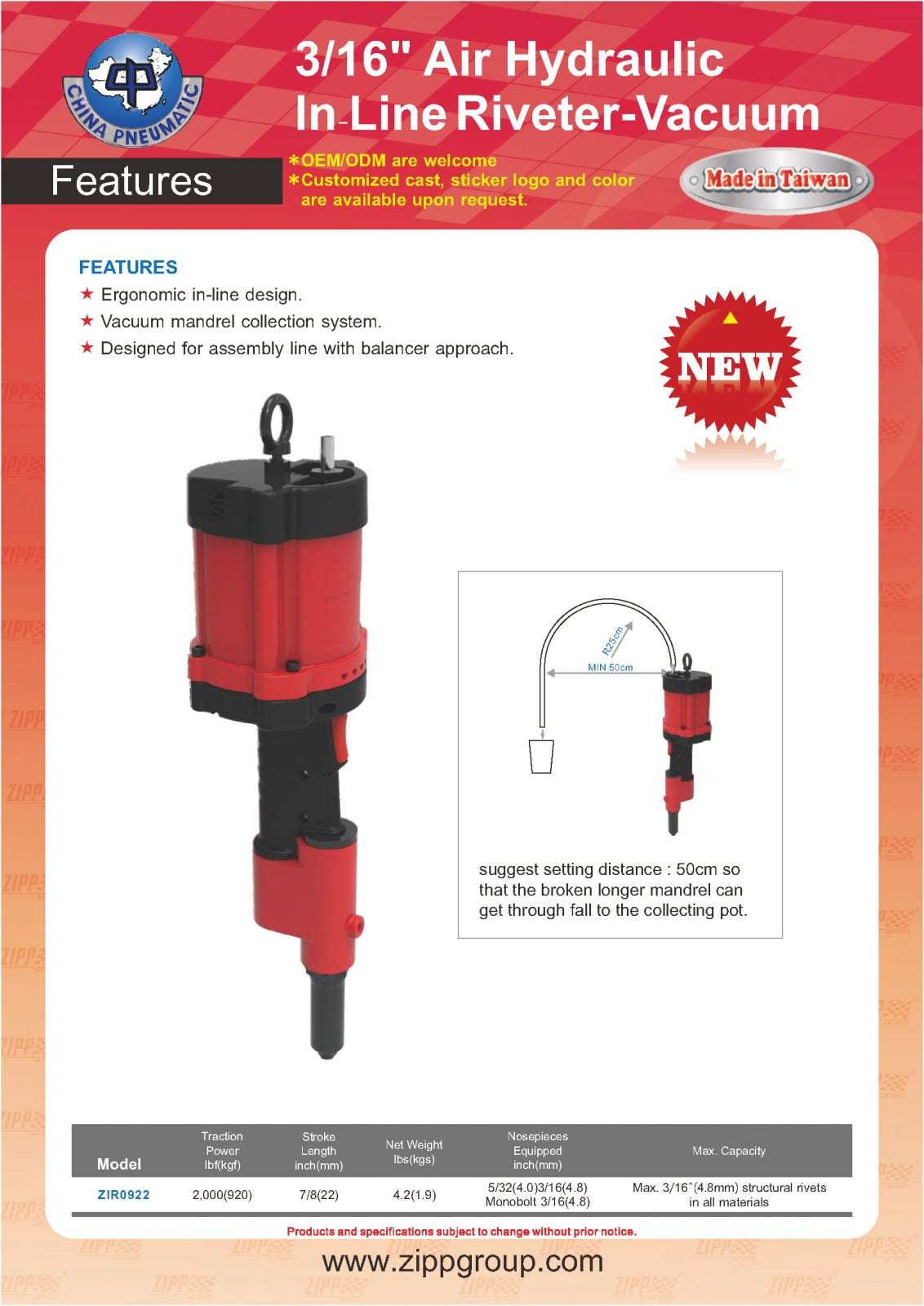
Split & Inline riveters designed for ergonomic and limited space

Split & Inline riveters designed for ergonomic and limited space

Split & Inline riveters designed for ergonomic and limited space


Split riveters are designed specifically for various types of rivets with minimal access. The tools transmit power from the power unit through a flexible hose to a small, lightweight head. By utilizing the proper pulling head, design problems and operator fatigue can be reduced dramatically.


2019 ZIPP General Catalog 頁面 061 2019 ZIPP General Catalog 頁面 062

TMS Bolting Process Monitoring on Non-Shut-Off Tools

TMS Bolting Process Monitoring on Non-Shut-Off Tools


TMS Bolting Process Monitoring on Non-Shut-Off Tools – Demonstrate how to set up and achieve torque-controlled results using the torque substitute value, the Torque or Timer feature notification, and the data logging feature with a wireless torque transducer on non-shut-off tools.


ZIPPTORK’s TTES Series Wireless Torque Transducer: Durable and Precise Torque Measurement – Specifically designed for monitoring the torque tightening process with comprehensive data collection and analysis software.

TMS Bolting process monitoring with auto shut-off tools

TMS Bolting process monitoring with auto shut-off tools


Demonstrate the data logging feature with a wireless torque transducer on auto-shutoff tools.


ZIPPTORK’s TTES Series Wireless Shock & Impact Proof Torque Transducer: Advanced Torque Measurement with Durability and Precision – Designed for torque tightening process monitoring with fully-featured data collecting and data analysis software

Why do airplanes use millions of rivets instead of welding?

Why do airplanes use millions of rivets instead of welding?

Z7000A 8 inch Alligator Squeezer
Z7000A 8-inch Alligator Squeezer


In modern aircraft manufacturing, where safety and reliability are non-negotiable, millions of rivets must be installed with absolute precision. As discussed, riveting remains the backbone of aircraft assembly because it preserves material strength, ensures fatigue resistance, and allows for flexible load distribution — qualities that welding cannot provide for thin aluminum alloys or advanced composite structures.


This is where the ZIPP Alligator Squeezer becomes an invaluable partner on the production line. Unlike conventional riveting methods that rely on heavy pneumatic hammers or guns, the Alligator Squeezer delivers a controlled, uniform squeeze force to form rivets without vibration or distortion. Its unique C-yoke design allows technicians to reach confined or hard-to-access areas of the fuselage, wing panels, and internal structures — places where precision and consistency are critical.


For thin-gauge aluminum skin or countersunk rivets used on stealth fighter surfaces, the Alligator Squeezer ensures each rivet is perfectly set, flush with the skin, and within aerospace tolerances. The tool’s consistent squeeze also minimizes operator fatigue and reduces the risk of human error, which is crucial when installing tens of thousands of rivets on a single aircraft.


By integrating the Alligator Squeezer into riveting operations, manufacturers can achieve:


  • Higher rivet quality — uniform deformation, correct head shape, and reduced risk of micro-cracks around rivet holes.

  • Improved productivity — faster installation with less rework compared to hammer riveting.

  • Enhanced safety — vibration-free operation protects workers from Hand-Arm Vibration Syndrome (HAVS).

  • Access flexibility — ability to work in tight fuselage spaces where other riveting tools cannot reach.


Z10AH-6 6 inch Alligator Squeezer
Z10AH-6 6-inch Alligator Squeezer
5000A Z4000A Alligator Squeezer


Just as rivets form the invisible backbone of every safe flight, ZIPP Alligator Squeezer plays a crucial role in ensuring that every rivet is installed to the highest aerospace standards. It’s a tool designed not only to meet the demands of today’s aircraft manufacturing but also to support the next generation of advanced airframes.


For more information, please visit our range of rivet squeezer products here

Transforming Traditional Torque Tools Into Smart, Transducerized Tools

How ZIPPTORK’s Wireless Rotary Torque Transducer Enables Real-Time Verification and Complete Data Collection


In modern manufacturing, torque accuracy is now essential rather than optional—it’s vital for ensuring product reliability, safety, and adherence to global quality standards. However, most factories still depend on traditional torque tools—impact wrenches, pulse tools, pneumatic tools, and many electric tools—that lack torque feedback and data traceability.


ZIPPTORK’s Wireless Rotary Torque Transducer (TTES / TTEB / TTAS / TTEH Series) completely transforms this. By connecting directly between the tool and the fastener, it turns any legacy torque tool into a smart, transducer-equipped, data-driven device, allowing for torque verification, real-time measurement, process monitoring, and automatic data collection on every fastening cycle.


1. Real-Time Torque Verification—Directly on the Production Line


Traditional calibration checks require removing the tool from the assembly line and testing it on a bench tester, which only verifies performance at that moment. But ZIPPTORK’s wireless rotary torque transducer performs in-line verification during actual tightening operations.


How it works


  • Installed between the tool and the socket/bit.
  • Measures torque during real fastening (including dynamic torque profiles of impact and pulse tools).
  • Sends real-time data wirelessly (BLE/RF) to a controller, gateway, or PC.


This provides:


  • Instant verification that the tool is delivering the correct torque.
  • Immediate detection of calibration drift or mechanical issues.
  • Data to validate every single fastener, not just sample checks.


With ZIPPTORK, torque verification becomes continuous—not periodic.


2. Complete Data Collection for Every Task and Every Fastening


Many industries (automotive, aerospace, heavy equipment, energy) now require 100% traceability for critical joints. ZIPPTORK’s transducers make this possible without replacing existing tools.


What data can be collected from every tightening?


  • Peak torque
  • Angle (optional with integrated angle encoder)
  • Torque curve profile
  • OK/NOK judgment
  • Time Stamp
  • Operator ID and station ID
  • Cycle count and tool performance trend


Where the data goes


ZIPPTORK’s wireless transducer can connect to:


  • ZIPPTORK Torque Controller (TCA / TCB / TCC)
  • ZIPPTORK TMS Software (Torque Management System)
  • MES/ERP/QMS systems through APIs
  • Cloud dashboards or factory IIoT analytics platforms


This turns every fastening point into a source of actionable manufacturing data—critical for Industry 4.0.


3. Upgrade Any Existing Torque Tool into a Transducerized Smart Tool


Most torque tools on the market—air impact wrenches, hydraulic torque wrenches, pulse tools, and many DC tools—are not transducerized, meaning they provide no torque feedback.


ZIPPTORK changes that.


Compatible tool types


  • Pneumatic impact wrenches
  • Pneumatic pulse tools
  • Air ratchets
  • Cordless impact wrenches
  • Cordless assembly tools
  • Manual torque wrenches
  • Torque multipliers / Nutrunners
  • Hydraulic torque wrenches


Immediate upgrade benefits


With one installation:


  • The tool becomes a torque device with built-in feedback.
  • The factory can perform accurate torque verification during production.
  • Every fastening is automatically recorded.
  • No need to buy expensive transducerized DC tools.


This approach dramatically reduces investment costs while maintaining (or improving) data traceability.


4. Improving Production Quality and Reducing Rework


Using ZIPPTORK’s wireless rotary transducer directly improves production efficiency and quality control.


Key benefits


  • Eliminates quality escapes by catching torque deviation immediately
  • Reduces rework and warranty claims through full traceability
  • Identifies worn tools early through torque signature analysis
  • Accelerates root-cause analysis with detailed torque curves
  • Supports certification & compliance (ISO 5393, VDI/VDE, automotive standards)


For global OEMs and Tier 1 suppliers, these benefits directly translate to lower costs and more stable production.


5. Plug-and-Play Integration with Industry 4.0 Systems


ZIPPTORK’s wireless transducer is engineered for modern connected factories:


  • Supports BLE 5.0, RF proprietary, and optional Wi-Fi gateways
  • Low power consumption for over 8 hours of operation
  • Highly impact-resistant design for use with pulse and impact tools
  • Compact modular mechanical design fits various tool sizes


The transducer becomes a smart sensing node within the customer’s IIoT network—turning raw torque processes into valuable, analyzable data streams.


6. A Practical Upgrade Path for Manufacturers Worldwide


Instead of replacing their entire fleet of pneumatic or cordless tools with expensive DC transducerized tools, manufacturers can:


Option A: Keep existing tools


Option B: Add ZIPPTORK Wireless Rotary Transducers


Result: Achieve complete digitalization and torque traceability at a fraction of the cost.


This makes ZIPPTORK a powerful solution for:


  • Automotive final assembly
  • Heavy machinery
  • Truck and bus manufacturing
  • Aerospace MRO
  • Wind turbine construction
  • Industrial equipment assembly
  • Any critical bolting process


ZIPPTORK’s Wireless Rotary Torque Transducer is more than a measurement device—it is a complete, innovative tool upgrade platform. By providing real-time torque verification and comprehensive fastening data, it converts traditional torque tools into intelligent, connected, transducerized tools suitable for modern Industry 4.0 environments.


Factories gain a practical, cost-effective path to achieving:


  • Full traceability
  • Better quality control
  • Reduced downtime
  • Data-driven process optimization


And most importantly: every fastening becomes verifiable, recordable, and trusted.

How to Improve Torque Control with In-Process Monitoring

Enabled by ZIPPTORK Wireless Rotary Torque Transducers


Modern assembly processes generate vast amounts of fastening data in real time. When captured and analyzed correctly, this data provides manufacturers with powerful insights to make more intelligent process decisions, reduce quality failures, and maximize productivity.


In critical bolted joints, relying solely on post-process inspection is no longer sufficient. Today’s manufacturers require in-process monitoring—the ability to evaluate fastening quality as the operation is performed continuously.


What Is In-Process Torque Monitoring?


A smart torque control system equipped with a torque transducer continuously measures applied torque throughout the fastening cycle and feeds this data back into the control system. In-process monitoring refers to the real-time assessment of fastening parameters—such as torque, angle, speed, and time—to verify joint quality during assembly rather than after completion.


By monitoring these parameters in real time, manufacturers can:


  • Detect fastening abnormalities immediately
  • Prevent defective assemblies from moving downstream
  • Reduce scrap and rework rates
  • Improve process consistency and repeatability
  • Minimize variability and quality risk


With in-process monitoring, every fastening operation becomes a verified process. Any deviation from predefined limits can trigger instant feedback, alarms, or corrective actions, ensuring issues are addressed before they escalate into costly failures.


The Role of ZIPPTORK Wireless Rotary Torque Transducers


ZIPPTORK’s wireless rotary torque transducers are designed specifically to enable reliable in-process torque monitoring on dynamic power tools, including impact wrenches, pulse tools, torque multipliers, and other rotary fastening equipment.


Unlike traditional inline or reaction-based sensors, ZIPPTORK’s transducers are mounted directly in the torque transmission path and rotate with the tool output. This design allows torque to be measured at the point of application, providing accurate, real-time data even under high vibration and impact conditions.


Key advantages of ZIPPTORK wireless rotary torque transducers include:


  • Accurate real-time torque measurement during the fastening process
  • Wireless data transmission, eliminating cables and slip rings
  • High resistance to shock and vibration, ideal for impact tools
  • Compact and tool-agnostic design, easily integrated into existing tools
  • Seamless connection to torque controllers, PLCs, and IIoT systems


By transforming conventional torque tools into data-enabled smart tools, ZIPPTORK allows manufacturers to upgrade their fastening processes without replacing entire tool fleets.


Improving Torque Control Through Real-Time Feedback


When integrated with a torque controller or production monitoring system, ZIPPTORK’s wireless rotary torque transducer provides continuous feedback throughout the fastening cycle. This enables:


  • Real-time verification that the target torque is achieved
  • Immediate detection of joint issues such as cross-threading, stripped threads, or inconsistent clamp load behavior
  • Automatic tool shut-off or process alerts when abnormal torque signatures are detected
  • Closed-loop torque control for improved accuracy and repeatability


The deeper the visibility into the fastening process, the greater the ability to correct problems instantly and make continuous improvements. Instead of reacting to failures discovered later, manufacturers can prevent defects at the source.


Turning Fastening Data into Process Intelligence


Beyond immediate quality control, the data collected by ZIPPTORK’s wireless torque sensing solutions creates long-term value. By analyzing fastening data across shifts, tools, and production lines, manufacturers gain insights into:


  • Process capability and stability
  • Tool performance and maintenance needs
  • Joint behavior and variation trends
  • Opportunities to optimize cycle time and workflow


This data-driven approach supports predictive maintenance, continuous improvement programs, and smart manufacturing initiatives under Industry 4.0 and IIoT frameworks.


In-process torque monitoring is no longer a luxury—it is a necessity for manufacturers seeking higher quality, lower risk, and greater productivity. By enabling real-time torque measurement directly on dynamic power tools, ZIPPTORK’s wireless rotary torque transducers bridge the gap between traditional fastening equipment and intelligent manufacturing systems.


With ZIPPTORK, torque control evolves from a reactive inspection task into a proactive, data-driven process—delivering measurable improvements in quality, efficiency, and operational confidence.


For more information, please click here.

Real-Time Insight for Every Fastening with Wireless Rotary Torque Transducer

In modern manufacturing, fastening is no longer “just tightening a bolt.” Every critical joint is part of a traceable quality chain, and every missed or over-tightened bolt can become a warranty claim, a line stoppage, or a safety incident. This is precisely where the ZIPPTORK wireless rotary torque transducer delivers its value: it transforms any torque tool into a smart, data-driven tightening system.


Turning any torque tool into a smart tool


Traditional torque tools—pneumatic impact wrenches, pulse tools, DC/cordless nutrunners, electric screwdrivers, torque multipliers — are workhorses on the line, but most of them are “blind.” They deliver torque, yet the process itself is not directly measured. Quality is inferred from occasional audits rather than continuously verified for each bolt.


The ZIPPTORK wireless rotary torque transducer changes that by:


  • Mounting directly between the tool and the socket or fixture
  • Measuring actual dynamic torque in real time, even under impact or pulsation
  • Transmitting live torque data wirelessly to a controller, PLC, or IIoT gateway


In other words, you keep your existing tools, but instantly add a precise, intelligent sensor layer on top of them.


1. Real-time process monitoring and traceability


The most important benefit is simple but powerful: you see what is happening at the joint in real time.


With ZIPPTORK’s wireless rotary torque transducer:


  • Each tightening event produces a live torque curve, not just a pass/fail lamp.
  • Supervisors can monitor torque levels, angle (if integrated), and time profiles as the joint is tightened.
  • Every bolt tightening can be logged with torque/time data, operator ID, tool ID, and timestamp.


This enables:


  • 100% process monitoring instead of sampling-based audits
  • Traceability for every fastener, which is increasingly required by OEMs and Tier-1 suppliers
  • Immediate visualization of anomalies such as cross-threading, missing parts, or hard/soft joint variations


When a customer asks, “How do you know this joint was tightened correctly?”, you no longer answer with assumptions—you show recorded evidence.


2. Easy integration with any torque tool


A major practical advantage of ZIPPTORK’s solution is its tool-agnostic design.


The wireless rotary torque transducer can be integrated with:


  • Pneumatic impact wrenches
  • Hydraulic and pneumatic pulse tools
  • DC and cordless nutrunners
  • Electric screwdrivers and torque tools
  • Torque multipliers and gearboxes
  • Custom automated tightening spindles


Instead of replacing entire tool fleets with expensive “smart tools,” manufacturers can:


  • Retrofit existing tools with wireless torque sensing
  • Standardize process monitoring across different tool brands
  • Phase in smart fastening capability line by line, station by station


This dramatically reduces the upfront investment and allows companies to move toward Industry 4.0 at their own pace, without scrapping tools that still have years of life left.


3. Elimination of cable problems in harsh environments


Cable-based rotating torque sensors are notoriously tricky to use in real production:

  • Cables get twisted, damaged, or cut.
  • Slip rings require regular maintenance and still introduce noise and reliability issues.
  • Operators dislike extra cables hanging from tools—they interfere with movement and ergonomics.


ZIPPTORK’s wireless rotary torque transducer eliminates these problems:

  • No rotating cable between the sensor and the receiver
  • No slip rings needed
  • Reduced risk of downtime from broken or tangled cables.


This is especially critical in high-vibration, high-impact applications such as:

  • Truck and bus wheel assembly
  • Construction equipment and heavy machinery
  • Wind turbine hub and flange bolting
  • Rail, shipbuilding, and large structural joints


The transducer is designed to survive the same tough conditions as the torque tool itself, making it a practical choice for real industrial use, not just a lab instrument.


4. Improved fastening quality and reduced rework


With real-time torque curves and wireless feedback, engineers can optimize the tightening process instead of guessing:


  • Define optimal torque windows and shut-off points
  • Detect abnormal joint behavior (e.g., stripped threads, missing washers, misalignment)
  • Identify variation between tools, operators, or shifts


As a result:


  • Rework is reduced because issues are caught immediately at the station
  • Line stoppages caused by fastening problems are minimized
  • Final inspection may become simpler or faster due to the trusted process data upstream


Quality teams gain a continuous stream of fastening data for statistical process control (SPC), capability studies, and continuous improvement projects.


5. Enabling predictive maintenance for tools


Tools wear out. Impacts get weaker, clutches drift, pulse units lose efficiency. Usually, this is noticed only after quality issues arise, or when operators complain that “the tool feels weak.”


By continuously monitoring torque output with ZIPPTORK:


  • You can track the actual delivered torque trend over time for each tool.
  • A gradual decline in production can be identified before it becomes a quality problem.
  • Maintenance can be scheduled based on performance, not just calendar time.


This transforms maintenance from reactive (“Fix it when it fails”) to predictive (“Service it before performance drops below spec”). The outcome is:


  • Fewer unexpected breakdowns
  • Extended tool life
  • More stable tightening performance across the line


6. Seamless integration with MES, PLC, and IIoT systems


ZIPPTORK’s wireless rotary torque transducer is designed with connectivity in mind. When paired with the appropriate controller or gateway, torque data can be:


  • Sent to PLCs for immediate OK/NOK decision logic
  • Logged in MES or QMS systems for traceability records
  • Streamed to cloud-based IIoT platforms for analytics and dashboards


This allows manufacturers to:


  • Consolidate tightening data with other production information (e.g., serial numbers, test results, operator information)
  • Implement advanced analytics to correlate torque behavior with failures, scrap, or warranty claims.
  • Build dashboards for plant managers that show fastening quality in real time across multiple lines or factories.


In short, the rotor and sensor at the wrench become the frontline data sources for your digital factory.


7. Flexible deployment: audits, development, and complete in-line control


Another practical advantage of ZIPPTORK’s rotary transducer is its flexibility in deployment. It can be used in several ways:


  1. Tool audits and calibration checks
    • Quickly verify whether tools still deliver the specified torque in real working conditions.
    • Compare different tool models or brands under the same joint conditions.
  2. Process development and optimization
    • Fine-tune torque settings, pulse times, or shut-off parameters when introducing new models.
    • Understand joint behavior (soft, hard, prevailing torque, etc.) before locking in the process window.
  3. Permanent in-line monitoring
    • Keep the transducer on the tool or station as a permanent process monitoring element.
    • Combine with controllers and poka-yoke logic to enforce correct tightening sequences.


This flexibility means you can start small—using a few systems for R&D and audits—and later scale to full line coverage once the benefits are proven.


8. Enhancing safety and compliance


In industries such as energy, pressure vessels, transportation, and structural engineering, improperly tightened bolts are more than a quality issue—they are a safety risk.


By integrating ZIPPTORK wireless rotary torque transducers:


  • Critical joints (flanges, lids, hubs, couplings, structural connections) can be tightened to validated torque levels.
  • Legal and regulatory requirements for documentation and traceability are easier to meet.
  • Customers get documented proof that each fastener was tightened within the required specification.


This not only reduces risk but also strengthens trust with end-users, inspectors, and certification bodies.


9. Cost-effective path to Industry 4.0 fastening


Many manufacturers hesitate to adopt fully integrated “smart tools” because of:

  • High upfront costs
  • Vendor lock-in
  • Uncertainty about return on investment


ZIPPTORK’s wireless rotary torque transducer offers a different path:

  • Use the tools you already own, from multiple brands.
  • Add smart torque monitoring where it matters most—on critical joints, key stations, or new product lines.
  • Scale up gradually: one station, one line, one plant at a time.


The result is a cost-effective, low-risk strategy to upgrade fastening processes to Industry 4.0 standards without a disruptive overhaul.


The ZIPPTORK wireless rotary torque transducer is more than a sensor; it is a bridge between traditional torque tools and modern smart manufacturing. By integrating directly with almost any torque tool and streaming real-time torque data wirelessly, it delivers:


  • Continuous process monitoring and full traceability
  • Higher product quality and reduced rework
  • Predictive maintenance and extended tool life
  • Seamless integration with PLC, MES, and IIoT systems
  • A flexible, economical path to Industry 4.0 fastening


For manufacturers facing stricter quality demands, more complex assemblies, and pressure to digitalize their operations, ZIPPTORK provides a practical, scalable way to turn everyday torque tools into intelligent, data-driven assets—without starting from scratch.

This website uses cookies to ensure it works properly and to help us understand how visitors use the site. Cookies are small text files stored on your device. By using this website, you consent to our use of cookies.